


Article: Durable Work Clothes for Women: 5 Pants That Last

Durable Work Clothes for Women: 5 Pants That Last
Table of Contents
- Why Durable Work Clothes for Women Are Worth the Investment
- How We Evaluated: Fabric, Construction, and Cost Per Wear
- 5 Durable Women's Work Pants That Hold Up
- Business Casual Outfits for Women: Building Around One Pant
- Workwear Fabric Guide: What Lasts and What Doesn't
- How to Care for Work Clothes So They Last Years
- Which Pair Should You Pick?
- Frequently Asked Questions
Last Updated: October 21, 2026
Why Durable Work Clothes for Women Are Worth the Investment
Durable work clothes for women solve an expensive problem: office pants shouldn't need replacing every season.
A pair that survives several years costs less per wear than three cheap pairs that pill, fade, and lose shape.
Below, we break down five pairs, how we judge construction, and which one fits your week.
How We Evaluated: Fabric, Construction, and Cost Per Wear
Most workwear roundups stop at "quality fabric," which tells you nothing comparable across brands. We judge durable women's work pants on four measurable things: fabric weight and blend, construction, repairability, and cost per wear, a checklist you can run on any pair.
Fabric weight and blend
Fabric weight is the most useful number a workwear listing can give you, and it's almost always missing. It's expressed in ounces per square yard (oz/yd²):
- Under 6 oz/yd²: lightweight shirting and summer poplin. Comfortable, but it will show abrasion at the seat, knees, and thigh within a season of hard daily wear.
- 6-9 oz/yd²: the practical middle for office and light-utility pants. Enough body to hold a crease and resist pilling without feeling like canvas.
- 10 oz/yd² and up: true workwear territory, canvas, heavy twill, denim. Durable, but slower to break in and warmer.
Blend matters as much as weight. Cotton-forward fabrics (roughly 95-98% cotton with 2-5% spandex) hold shape and resist pilling. High-polyester blends are cheaper but pill and shine at friction points. Lyocell drapes beautifully but has lower abrasion resistance, suiting tailored, lower-friction roles.
Garment construction: what actually fails first
Pants fail at predictable stress points, and construction determines how long they last.
- Seams. Look for double-stitched or felled seams at the inseam and outseam. A single row of straight stitching is the first thing to split under load. Flat-felled seams hide the raw edge and add a second line of defense.
- Stitch density. Denser stitching, roughly 8-12 stitches per inch, distributes stress better than sparse, long stitches. You can count them on the inside of a hem in a few seconds.
- Bar tacks. These are the short, dense zigzag stitches at pocket corners, belt loops, and fly stress points. Their absence is a reliable warning sign that a pair is built for looks, not load.
Abrasion resistance and how to sanity-check it
There's no consumer-facing abrasion score on a hangtag, but you can approximate one. Rub the fabric against itself and watch for fuzz. Pinch and release it to see whether it springs back or stays creased. Hold it to light, if you can read text through it, it's too thin for daily utility wear.
Repairability
A durable garment you can fix outlasts one you cannot. Look for generous seam allowances, replaceable buttons, and deep hems that can be let down.
Cost per wear
Cost per wear is the honest metric: price divided by the times you realistically wear the item before it fails. A $180 pair worn twice a week for three years (about 300 wears) lands near $0.60 a wear. A $40 pair that splits in six months (about 50 wears) costs $0.80 a wear, and you buy it again.
Criterion |
What We Look For |
Why It Matters |
|---|---|---|
Fabric weight and blend |
6-9 oz/yd², cotton-rich with 2-3% spandex |
Holds shape, resists pilling and wrinkling |
Seams and stitching |
Double-stitched or felled, 8-12 stitches per inch |
Survives load at stress points |
Reinforcement |
Bar tacks at pockets, belt loops, fly |
Prevents the most common failures |
Hardware |
Metal zipper, shank buttons |
Outlasts plastic in daily use |
Waistband construction |
Structured or securely stitched half-elastic |
Comfort without sagging or twisting |
Repairability |
Deep hems, replaceable buttons |
Extends life beyond first failure |
Cost per wear |
Under $2 per wear at realistic frequency |
Long-term value, not sticker price |
Care requirements |
Machine washable, low maintenance |
Actually gets worn |
5 Durable Women's Work Pants That Hold Up
These five pants cover the range of professional dressing, from boardroom-adjacent tailoring to physically active days. Each earns its place on construction and fabric.
Harry Stretch Poplin Cargo Pant ($128)
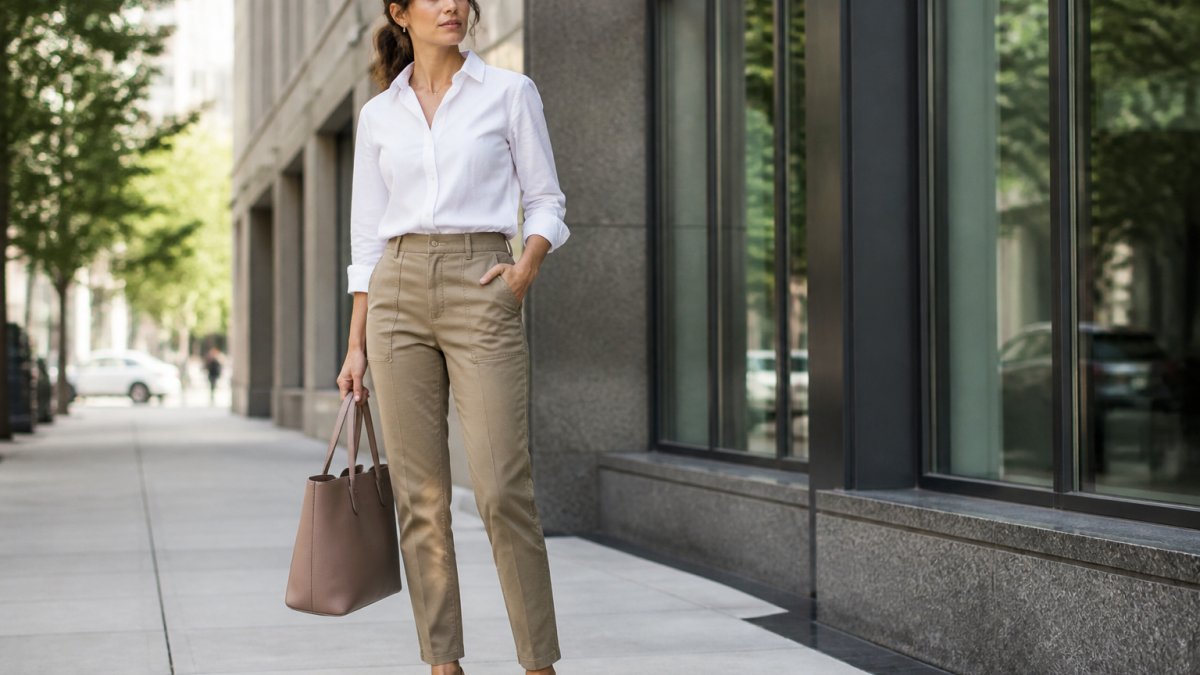
The Harry Stretch Poplin Cargo Pant is our best-selling pant and most versatile entry point: 97% cotton, 3% spandex, true to size, with a 32-inch inseam and a slim, relaxed fit.

Dual cargo pockets (one practical, one zippered) plus bold seaming and hardware give it an edge without tipping casual. It is a web exclusive, for a first pair of durable work clothes for women, start here.
Cyprus Stretch Twill Zip Utility Pant ($184)
Structured and quiet, the Cyprus Stretch Twill Zip Utility Pant is 98% cotton and 2% spandex with a constructed waistband, button closure, belt loops, and a cropped, modern 26-inch inseam.

A zip cargo pocket on the left leg adds function without bulk, and rivet details nod to classic workwear. This is the pair for polish first, utility second.
Lancel Calvary Twill Pant ($188)
The Lancel Calvary Twill Pant is the tailored option: subtle trouser pleats, a cropped 27.5-inch leg, and an adjustable button-tab hem that switches from relaxed wide leg to tapered in seconds.

The body is 97% Lyocell and 3% spandex, with a half-elastic rib waistband that keeps its structure. Deep functional pockets seal it, boardroom attire that still moves.
Alder Stretch Poplin 26" Barrel-Leg Pant ($176)
Cut full through the hip and tapered at the ankle, the Alder Stretch Poplin 26" Barrel-Leg Pant is 97% cotton and 3% spandex with a 26-inch inseam. Deep utility pockets hold a phone and keys without stretching out.
Five colorways from White to Ombre make it a year-round staple, and the barrel leg flatters curves without announcing itself.
Stellan Stretch Baby Cord Seamed Utility Pant ($180)
Fine corduroy brings texture to the lineup. The Stellan Stretch Baby Cord Seamed Utility Pant is 98% cotton and 2% spandex with a rib knit waistband, a 28-inch inseam, and curved seams that trace a relaxed shape.
Harry Stretch Poplin Cargo Pant →
Angled pockets add utility without bulk. Available in Falcon, Canteen, Light Caramel, Periscope, and Black, sizes 24 to 31. This is the cold-weather answer to durable women's work pants.
Business Casual Outfits for Women: Building Around One Pant
Business casual outfits for women get easier when one pant does the heavy lifting. Pick your pair first, then build up.
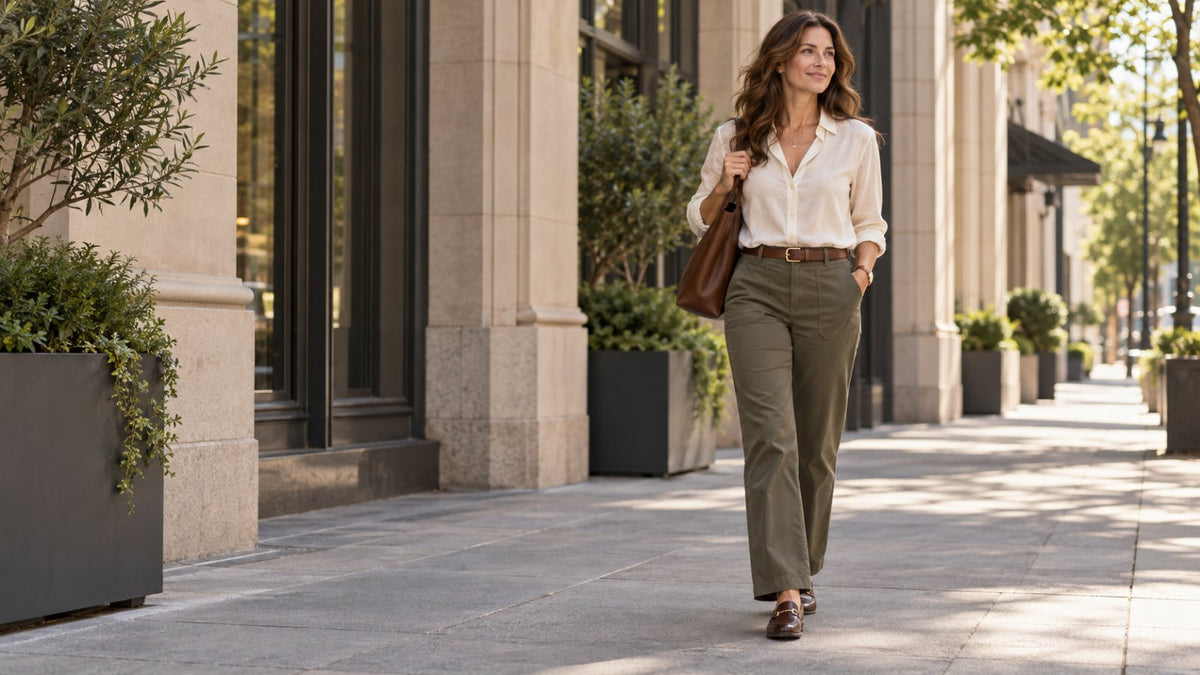
For the Cyprus or Lancel, add a crisp white blouse and loafers for a polished look; swap to a fitted knit and low boots for a softer Friday. The Alder pairs with a tucked tee and blazer for meetings, and the Stellan wants a fitted knit to balance its ease.
Accessories finish the work: a structured tote, a slim belt, and simple jewelry. Keep the palette tight and the pant carries the outfit.
Workwear Fabric Guide: What Lasts and What Doesn't
A workwear fabric guide starts with one rule: there's no single "best" durable fabric, only trade-offs between abrasion resistance, breathability, stretch recovery, care burden, and environmental impact. "Durable work clothes for women" means very different things at a desk and on a warehouse floor.
The core fabrics, compared
- Cotton poplin and twill. Breathable, holds shape, resists wrinkling when blended with a small amount of spandex. The backbone of durable office and light-utility workwear. Twill (a diagonal weave) is denser and more abrasion-resistant than plain-weave poplin at the same weight.
- Canvas and heavy denim (10 oz/yd² and up). The most abrasion-resistant common fabrics. Excellent for trades, warehouse, and outdoor work. Trade-offs: heavier, warmer, slower to break in, and stiffer until washed several times.
- Lyocell blends. Drape well and feel cool, with good shape retention in tailored cuts. Lower abrasion resistance than cotton twill, so best for lower-friction roles, office, client-facing, travel.
Stretch: the sweet spot and the failure mode
2-3% spandex is the practical sweet spot for work pants: mobility without sagging. Above about 5%, the garment loses recovery over time, knees bag and the seat sags. Heat kills spandex, which is why dryer habits matter as much as the fabric label.
Matching fabric to the job
Durability intent splits into at least two very different wardrobes:
- Office, client-facing, and business casual. Prioritize shape retention, wrinkle resistance, and a polished drape. Cotton-rich twill, poplin, Lyocell blends, and fine wool. You are optimizing for repeated wear and appearance, not abrasion.
- Trades, warehouse, healthcare, and outdoor work. Prioritize abrasion resistance, mobility, breathability, and easy laundering. Heavy cotton twill, canvas, denim, and tightly woven performance synthetics. Look for reinforced knees, gusseted crotches, utility pockets, and stretch panels at the waist and hips. Healthcare adds a fluid-resistance consideration; outdoor work adds wind and water resistance.
A pant built for a boardroom will not survive a loading dock, and a canvas work pant looks out of place in a client meeting. The durability question is always "durable for what?"
Material trade-offs and sustainability
Durability and sustainability overlap: the most sustainable garment is usually the one you keep wearing. Natural fibers biodegrade but can be water-intensive; synthetics are petroleum-based and shed microfibers but often outlast natural fibers in high-abrasion roles. Choose the fabric that matches your job, care for it, and repair it, extending life is the most reliable sustainability lever a shopper has.
What to avoid
- High-polyester blends that pill and shine at friction points.
- Thin fabrics with no weight (under roughly 5 oz/yd²) marketed as "workwear."
- Anything that requires dry cleaning to survive, it will not get worn.
For care standards, the FTC's Care Labeling Rule sets what manufacturers must disclose about washing and dry cleaning, which is a useful reference when a label feels vague.
How to Care for Work Clothes So They Last Years
Caring for work clothes comes down to washing less often, washing cold, and skipping the dryer.
- Wash inside out on cold to protect seams and color.
- Air dry flat or hang; heat is what breaks down stretch fibers.
- Treat stains immediately, before they set.
The American Cleaning Institute's fabric care guidance offers practical washing temperatures by fabric type if you want a reference beyond the label.
Which Pair Should You Pick?
Pick by your week, not the photo. For one pair that does everything, start with the Harry at $128. For corporate polish, the Lancel or Cyprus.
Pant |
Price |
Inseam |
Best For |
|---|---|---|---|
$128 |
32" |
Everyday versatility, first pair |
|
Cyprus Stretch Twill Zip Utility |
$184 |
26" |
Polished office wear |
Lancel Calvary Twill |
$188 |
27.5" |
Boardroom-adjacent tailoring |
Alder Stretch Poplin Barrel-Leg |
$176 |
26" |
Relaxed, curve-flattering fit |
Stellan Stretch Baby Cord |
$180 |
28" |
Cooler months, texture |
Cost per wear settles the rest. At two wears a week, any of these lands under two dollars a wear within a year, and keeps dropping from there.
Frequently Asked Questions
What fabrics last longest for women's work clothes?
Cotton and cotton-blend twills hold up best for daily office wear because they resist pilling and keep their shape through repeated washing. Look for a small amount of spandex, usually 2% to 3%, so the fabric recovers instead of stretching out at the knees and seat. Lyocell blends drape well and resist wrinkles but need gentler care. Pure synthetics tend to pill faster at friction points like the inner thigh. Check the care label and the fabric weight before you buy; a mid-weight twill outlasts a thin poplin every time.
How can you tell if work clothes are well made?
Start with the seams. Reinforced stitching at stress points, clean finished edges, and no loose threads signal a garment built to last. Check the waistband construction: a properly constructed waistband with interfacing keeps its shape after months of wear, while a flimsy one rolls and stretches. Look at pocket depth and placement, since shallow pockets that pull at the seam are a common failure point. Fabric weight matters too. A durable women's work pant should feel substantial without being stiff, and hardware like zippers and buttons should operate smoothly.
How do you make office clothes last longer?
Wash less often and air garments between wears, which cuts down on fiber breakdown. Turn pants inside out before washing to protect the outer surface, use cold water, and skip the dryer in favor of hanging to dry. Store work pants on hangers rather than folded in a drawer to avoid crease wear. Treat small repairs early: a loose button or a frayed hem costs minutes to fix and prevents a bigger failure later. Rotating between three or four pairs rather than wearing one pair daily spreads the wear and extends the life of each garment.
What are the best versatile workwear staples for women?
A well-fitted pair of tailored work pants does more for a wardrobe than any other single piece, since it moves between office, travel, and weekend settings. Pair it with a crisp white blouse for meetings, a knit for casual Fridays, or a blazer for boardroom days. Add a structured tote bag and loafers to complete a polished look. Build around pieces that work in three settings or more, and favor durable work clothes that hold their shape through regular wear. A capsule wardrobe of five or six versatile pieces covers most of the week.
The real challenge with durable work clothes for women is not finding options, it is finding pieces that hold their shape and finish after a year of real wear. That is exactly what Marrakech Clothing designs for: cotton-rich stretch fabrics, thoughtful construction, and silhouettes built to move with you. Browse the collection, check the fit details, and start with one pair you will actually wear twice a week. SHOP NEW.
Leave a comment
This site is protected by hCaptcha and the hCaptcha Privacy Policy and Terms of Service apply.